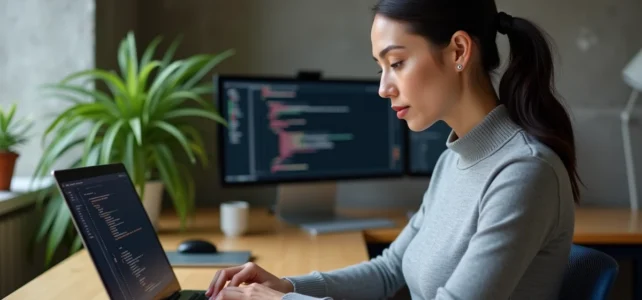
A workstation that lags when compiling a project, a home Wi-Fi network saturated by a dozen connected devices, a generative AI tool returning inconsistent results due to lack of framework: these everyday situations dictate the technical priorities of the current period. The IT trends of 2026 are not just announcements from trade shows. They translate into concrete choices of hardware, network configuration, and software governance.
NPU and AI PCs: what local processing changes for a workstation
Since spring 2024, manufacturers like ASUS and Lenovo have been delivering machines equipped with NPUs dedicated to local artificial intelligence. Microsoft’s Copilot+ range is the most visible example of this. In practice, this means that a workstation can perform real-time translation, search through a file history, or assist in writing without sending each request to a remote server.
For those following the IT universe on Infiniti Geek, this shift towards embedded processing changes the criteria for choosing a computer. The processor and amount of RAM are no longer sufficient as criteria: the presence and power of the NPU now determine the smoothness of AI functions on a daily basis.
In practice, the difference is mainly felt in repetitive tasks: code suggestions in an IDE, automatic summarization of long documents, semantic search in local files. For classic office tasks, the contribution remains marginal. The NPU becomes a relevant purchasing criterion as soon as AI is used multiple times a day, not before.
Securing your home IoT network: the actions that really matter
You plug in a connected camera, a smart thermostat, a voice speaker, and the home Wi-Fi network turns into an attack surface. Tech content in 2026 emphasizes one specific point: securing connected devices is no longer a bonus; it is a priority on par with antivirus on PCs.
Feedback varies on this point depending on configurations, but a few measures have consensus among network administrators.
- Systematically change the default password of each connected device as soon as it is set up, including devices that seem innocuous (light bulbs, smart plugs).
- Create a guest Wi-Fi network dedicated to IoT devices, separate from the main network used by computers and smartphones, to limit propagation in case of compromise.
- Enable automatic firmware updates on each device, or schedule a monthly check when the automatic option does not exist.
This network segmentation requires a few minutes of configuration on the box or router. Most recent operator interfaces offer the function directly in the advanced Wi-Fi settings.
AI governance in business: the new filter for selecting tools
IT managers are no longer just asking if a tool integrates AI. The question now concerns how this AI is framed. The trends for 2026 highlight the establishment of governance frameworks, audit tools, and compliance for every project involving a machine learning model.
In concrete terms, this covers three axes: the traceability of the models used (which dataset, which version), the management of algorithmic biases, and the protection of personal data injected into the systems. These criteria become a selection filter when choosing a provider or a SaaS solution.
What this implies for a technical team
On the ground, internal evaluation sheets are appearing before any deployment of an AI tool. The team checks if the provider documents the origin of its training data and whether it offers an audit mechanism. A tool without governance documentation becomes a legal risk as much as a technical one.
For smaller organizations that do not have a dedicated IT manager, the minimal reflex is to check the privacy policy of the service used and ensure that the submitted data is not used to retrain the model without explicit consent.

Windows system tips: three shortcuts that save time
The major trends should not overshadow immediate gains on the workstation. A few simple manipulations in Windows 10 and 11 improve daily productivity without installing anything.
- The clipboard history (Windows + V) retains the last copied items and allows you to paste text or an image retrieved several copies ago, instead of constantly navigating between windows.
- The shortcut Windows + Shift + S opens the selective screenshot tool, faster than the classic Snipping Tool for extracting a specific area.
- The combination Ctrl + Shift + T reopens the last closed tab in most browsers, an action that avoids searching through history after an accidental closure.
These shortcuts may seem basic, but their systematic adoption makes a real difference during a day of work spent in front of the screen. They can be integrated in just a few days of regular use.
The IT landscape of 2026 pushes to rethink three layers in parallel: hardware (with NPUs), network (with IoT segmentation), and processes (with AI governance). Each layer has a direct impact on the reliability and security of a digital environment, whether at home or in business.