
A hesitation in motorcycle acceleration manifests as a noticeable stutter or a loss of power when the throttle is twisted. The engine seems to gulp air for a split second before resuming its normal response. This phenomenon affects both carbureted motorcycles and recent fuel-injected models, but the causes differ significantly depending on the generation of the machine.
Ride-by-wire and ECU mapping: when electronics create the hesitation

On recent motorcycles equipped with an electronic throttle (ride-by-wire), the mechanical link between the throttle and the throttle valve no longer exists. An electronic unit interprets the rider’s request and controls the opening of the throttle according to a programmed mapping. This system offers remarkable precision, but it also introduces an intermediary that can create hesitations.
Feedback from dealers and users shows that hesitations can be linked to overly cautious settings of throttle management in certain riding modes. The rain mode or “Eco” mode, for example, intentionally limits the engine’s response. The hesitation sometimes simply disappears by switching to Sport mode.
ECU reflash campaigns have been conducted by some manufacturers to smooth out the response without any mechanical modifications. These mapping updates are documented in technical notes from manufacturers. If your motorcycle exhibits a hesitation that appeared without any apparent mechanical reason, a visit to the dealership to check the ECU software version may be enough to resolve the issue.
Traction control and anti-wheeling add an extra layer. These systems cut or reduce fuel injection to limit the power transmitted to the rear wheel. Field reports show that simply reducing the level of traction control, in safe conditions, eliminates these hesitation sensations without mechanical intervention. To resolve a motorcycle acceleration hesitation on a recent model, the electronic avenue is worth exploring before disassembling anything.
Clogged carburetor and blocked jets: diagnosis on carbureted motorcycles
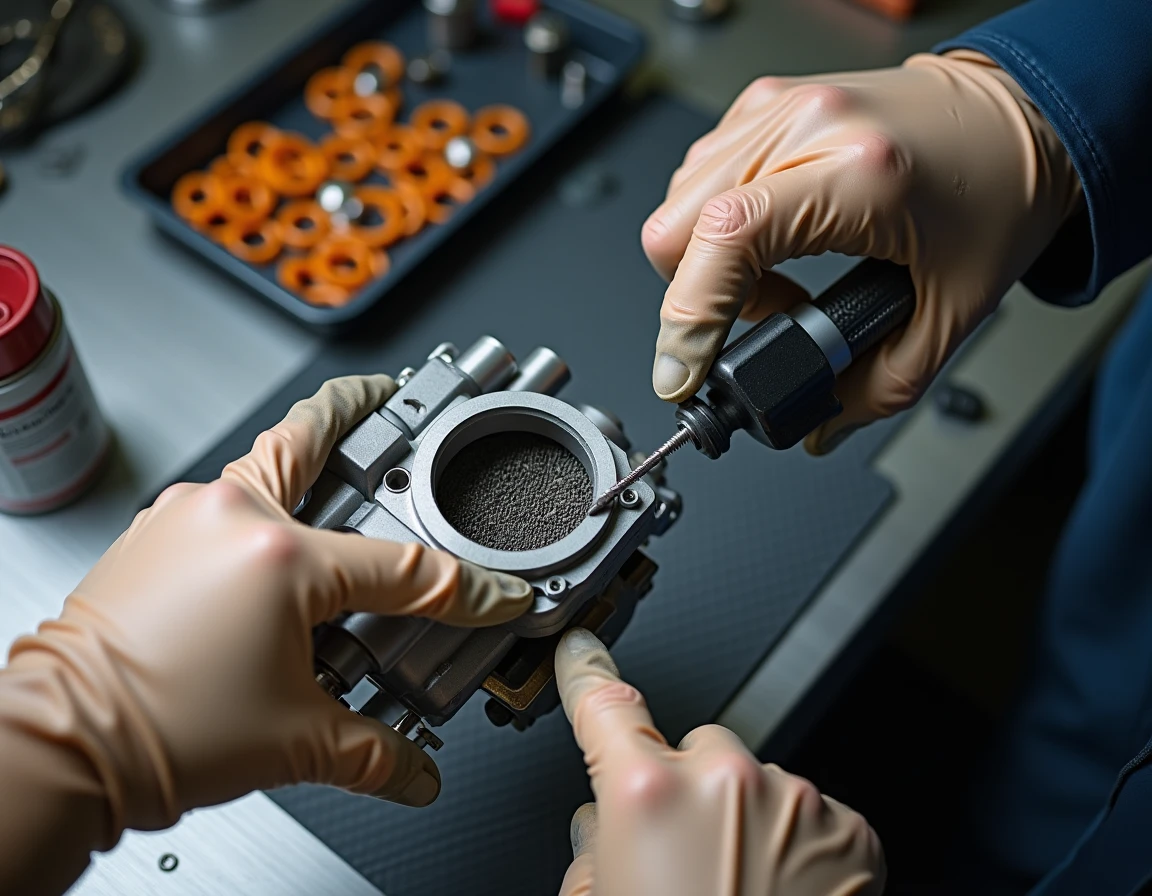
On carbureted motorcycles, the hesitation in acceleration almost always has a mechanical origin. The carburetor mixes air and fuel in precise proportions, and the slightest obstruction disrupts this mixture.
Jets and needle: the first suspects
The idle jet and the main jet control the fuel flow at different RPMs. A partially clogged jet due to fuel residues weakens the mixture at the precise moment when the engine demands more fuel. The needle, which regulates the fuel level in the bowl, can also stick or deform over time.
A complete ultrasonic cleaning of the carburetor remains the most reliable method to eliminate deposits without risking damage to brass parts. A simple cleaning spray does not always clear the finest passages.
Mixture screw and float height
Adjusting the mixture screw modifies the air/fuel ratio at idle and during initial acceleration. A quarter turn in either direction can transform the engine’s response. The float height determines the fuel level in the bowl: if it’s too low, it starves the engine during hard acceleration.
- Check the condition and cleanliness of the main and idle jets by removing them one by one for visual inspection
- Inspect the needle and needle seat for signs of wear or deformation
- Measure the float height with a ruler and compare it to the value indicated in the workshop manual
- Adjust the mixture screw in quarter-turn increments, with the engine warm, while observing idle stability
SP95-E10 fuel and older motorcycles: an often-overlooked factor
Since the widespread use of SP95-E10 in Europe, independent workshops have reported an increase in complaints of acceleration hesitations on motorcycles manufactured before 2010 that are not explicitly compatible with E10. Ethanol accelerates the aging of hoses, membranes, and needles.
The problem mainly manifests after a period of inactivity. Gasoline containing ethanol absorbs ambient moisture, leading to phase separation in the tank. The mixture that reaches the carburetor is then no longer homogeneous, causing the engine to hesitate or stall upon throttle opening.
The jets clog more quickly with fuel containing ethanol, especially if the motorcycle remains parked for several weeks. On an older machine, switching to SP98 without ethanol significantly reduces this risk. Closing the fuel tap and allowing the carburetor to empty before each extended storage period also limits deposit formation.
Ignition circuit and air supply: complementary avenues
An acceleration hesitation is not always related to fuel. The ignition circuit plays a direct role in combustion, and even a partial failure produces exactly the same symptom.
A worn or improperly gapped spark plug causes misfires that result in a clear hesitation during acceleration. The suppressor, coil, and high-voltage cables also deserve inspection, especially on single-cylinder motorcycles where every misfire is immediately felt.
On the air intake side, a clogged air filter restricts airflow and excessively enriches the mixture. Conversely, a vacuum leak (cracked intake manifold gasket, disconnected vacuum hose) randomly weakens the mixture. To detect a vacuum leak, a simple method is to spray brake cleaner around the intake connections while the engine is running: an immediate change in RPM indicates a leak.
- Replace the spark plug according to the manufacturer’s recommended interval and check the electrode gap
- Visually inspect the vacuum hoses and intake manifold gaskets for cracks
- Check the condition of the air filter and replace it if it is visibly saturated with dust or oil
The motorcycle acceleration hesitation rarely has a single cause. On a fuel-injected machine, mapping and electronic aids are the first factors to check. On a carbureted motorcycle, cleaning the jets and choosing the right fuel resolve the majority of cases.
Regardless of the type of engine, the most productive method remains to proceed by elimination, from the simplest to the most complex. Start with the spark plug and air filter before tackling the rest of the system.