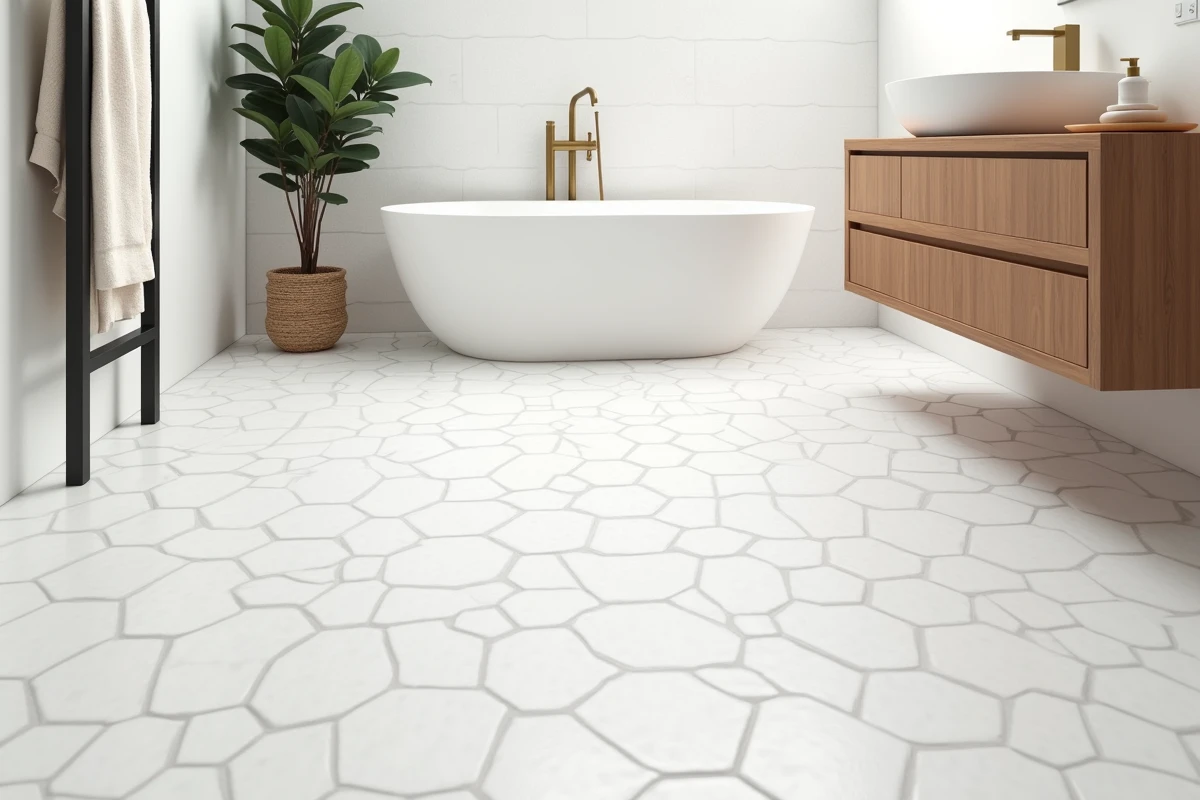
The white hexagonal tile is a ceramic or porcelain stoneware tile shaped with six equal sides, echoing the geometry of traditional terracotta tiles. Its white surface, whether matte or glossy, acts as a reflector of natural light and alters the perception of floor volumes. This format stands out from rectangular or square tiles due to the way the joints create a continuous pattern without visible linear alignment.
Joints and finishes: what really changes the appearance of white tiles
On a classic tile, the joint remains discreet. On a white hexagon, it becomes a graphic element in its own right. A dark gray joint against a white background highlights each cell and transforms the floor into a pronounced geometric composition.
Conversely, a white tone-on-tone joint softens the contours and creates an almost monolithic surface. The choice of joint influences the visual result more than the choice of the tile itself.
The surface finish plays a complementary role. A matte porcelain stoneware absorbs light and gives a mineral appearance similar to stone. A glossy glaze reflects light sources and amplifies the sense of space, but also reveals micro-scratches more quickly. For humid areas like the bathroom, a slightly textured finish ensures better grip on the floor without sacrificing brightness.
The choice of a white hexagonal tile for flooring therefore depends as much on the width and shade of the joint as on the tile itself.
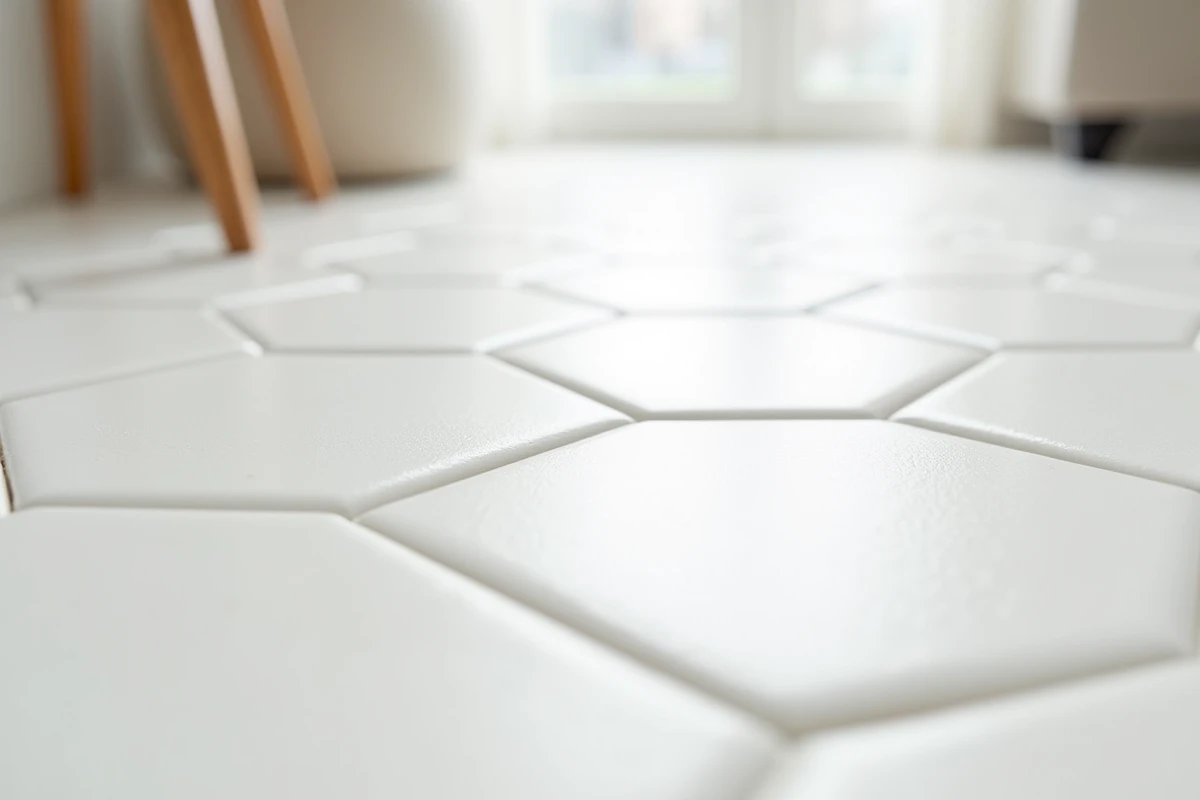
White hexagonal tiles as a zoning tool in open spaces
Open spaces (kitchen-living room, entrance-hallway) pose a recurring problem: defining functions without erecting partitions. White hexagonal tiles offer a flooring solution. Laid in the kitchen area or in the entrance, they create a clear visual boundary with the parquet or polished concrete of the adjacent room.
The hexagon-parquet transition works without a threshold strip. The tiles are cut with irregular edges to interlock with the wooden planks. This type of junction produces an organic gradient effect that draws the eye and structures the space.
This zoning technique also works in the bathroom, where a white hexagonal island delineates the walk-in shower from the rest of the floor. The white color enhances the visibility of the wet area while maintaining a bright ambiance.
Proportions to respect for effective zoning
- The hexagonal area must represent a sufficient surface to be perceived as a distinct space, not just a few isolated tiles
- The tile format influences the scale: a small hexagon (a few centimeters per side) is suitable for small areas like an entrance, while a larger format is better suited for an open kitchen
- The contrast between the two coverings (white hexagon and oak parquet, for example) must remain strong for the zoning to be readable from a distance
Color and pattern combinations with white hexagonal tiles
White alone on a large floor can appear flat. Recent trends show that white hexagons serve as a neutral base in tone-on-tone compositions, paired with decorative inserts or tiles in similar shades (light gray, beige, ivory).
Three aesthetic directions stand out depending on the desired ambiance.
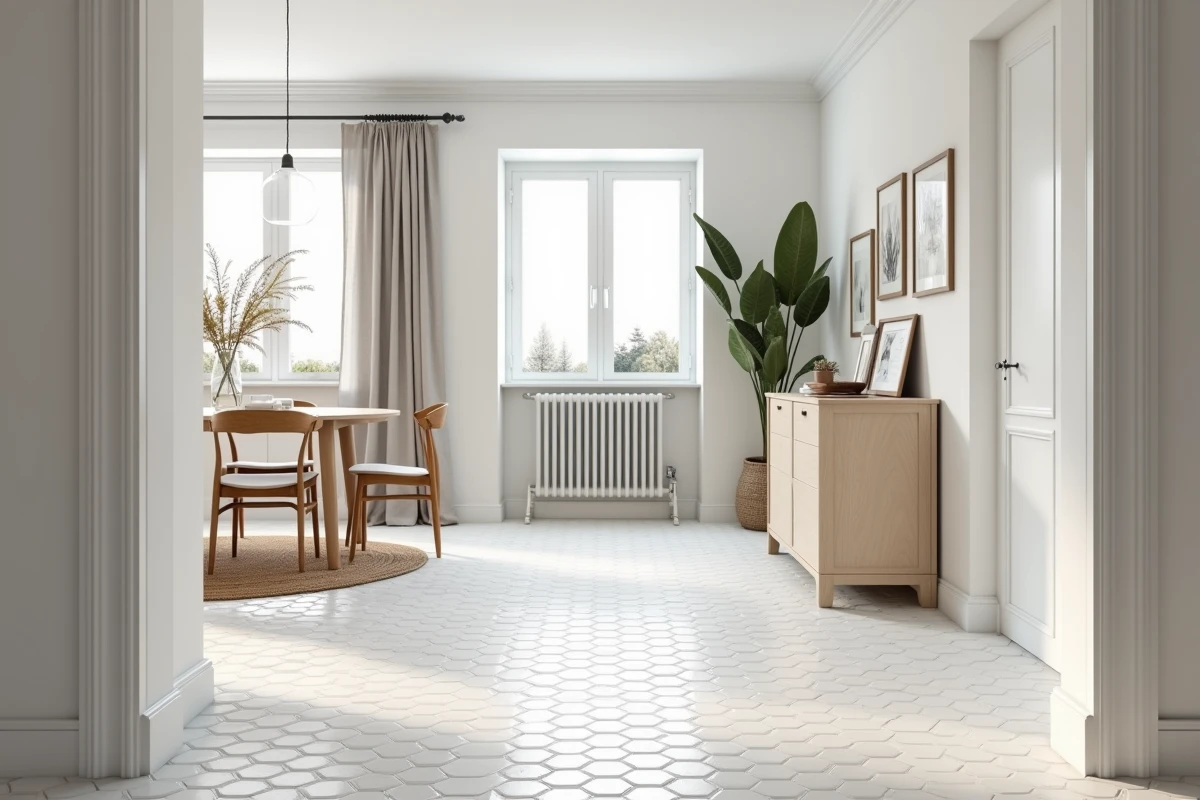
Scandinavian style
Matte white hexagons on the floor, light walls, natural wood. The joint remains white or very light. The overall effect produces a bright and uncluttered interior where the floor does not draw attention but amplifies the ambient clarity.
Graphic contemporary style
White hexagons mixed with black or dark gray hexagons, arranged in a random pattern or gradient. The black and white contrast transforms the floor into a central decorative element. This choice is suitable for rooms where the furniture remains understated.
Mediterranean ambiance
White hexagons combined with a few tiles featuring blue or terracotta patterns. The white dominates, but the colored inserts evoke Provençal terracotta or azulejos. This approach works well in a kitchen or a covered terrace.
Installation of white hexagonal tiles: technical constraints to anticipate
The installation of a hexagon differs from that of a straight tile in several ways. The layout must be marked on the floor before any gluing, as the interlocking of the six sides does not forgive misalignments. A one-millimeter gap on the first tiles will affect the entire surface.
The cutting at the perimeter generates more waste than with a rectangular format. The angles of the room require beveled cuts on each border tile. Allowing for extra material compared to the actual surface is a technical precaution, not a luxury.
- The substrate must be perfectly flat: on an uneven floor, the hexagonal edges create visible thicknesses at the joints
- A double gluing (adhesive on the back of the tile and on the floor) is recommended for formats exceeding a certain size, to avoid air pockets
- The drying time before grouting remains the same as for a classic tile, but the number of joints per square meter is higher, which extends the finishing time
The white hexagonal tile remains a format whose implementation requires longer preparation than the installation itself. A well-thought-out layout and a carefully leveled substrate determine the quality of the final result more than the price of the chosen tile.